
Guadalupe County Court Records After Jail Arrest
Guadalupe County court records after a jail arrest follow a local path. A person arrested by a sheriff's deputy, city police officer, DPS trooper, constable, or other law-enforcement agency may be booked at the Guadalupe County Adult Detention Center. The county jail page says booking includes a search, completion of the arrest report, fingerprints, a photograph, placement in a holding cell, and magistration when the judge's schedule permits. At magistration, the person is advised of rights and charges, and bail may be set under Texas procedure.
The court side starts when a prosecutor and clerk create or index the filed case. Guadalupe County's official prosecutor page is the County Attorney page, and the research points court-copy routing to the District Clerk for district criminal matters and to the County Clerk or County Courts at Law for county-level misdemeanor matters. Sheriff Joshua Ray's office operates the jail and the local booking process, but the charge record that controls case status belongs in the court and clerk system after filing.
Booking and court records answer different questions. The custody side can show why a person entered jail, whether a person is still held, and whether bond information is available. The court record shows the charge the prosecutor filed, the case number, hearings, warrants tied to the case, dispositions, and later record-clearing activity. For the custody side, use jail inmate records. For booking-photo limits, use the mugshot page. Court records after an arrest should be read as filed case records, not proof of guilt.
Search Guadalupe Court Records After Arrest
The official online starting point is Guadalupe County Tyler PublicAccess. County navigation labels the same portal for Criminal Case Search, Criminal Hearing Search, Judicial Records Search, JP Criminal Case Search, and Jail Records Search. Automated inspection on June 30, 2026 was blocked by AWS WAF human verification, so the exact live case-search fields were not confirmed. Use the portal as the official path, but do not assume a specific field label unless a human browser session confirms it.
- Start with the Tyler PublicAccess portal linked by Guadalupe County for judicial and criminal case records.
- Search with the defendant's name, case number, or hearing information if the portal offers those fields after verification.
- Open the criminal or JP criminal case result and compare the filed charge list with the jail booking date.
- Check each charge for level, count number, active or disposed status, and any warrant or failure-to-appear notation.
- Route felony and district court copy questions to the District Clerk, and county-level misdemeanor questions to the County Clerk or County Courts at Law.
The District Clerk page identifies that office as custodian for district court pleadings and papers at 211 W. Court Street in Seguin. The County Clerk is the county court records custodian, and the County Courts at Law page is the local venue route for many misdemeanor cases. Statewide criminal-history records are separate Texas DPS products. They are not a substitute for Guadalupe County court documents.
The captured image from Tyler PublicAccess shows the official portal route used for Guadalupe County jail and judicial searches.
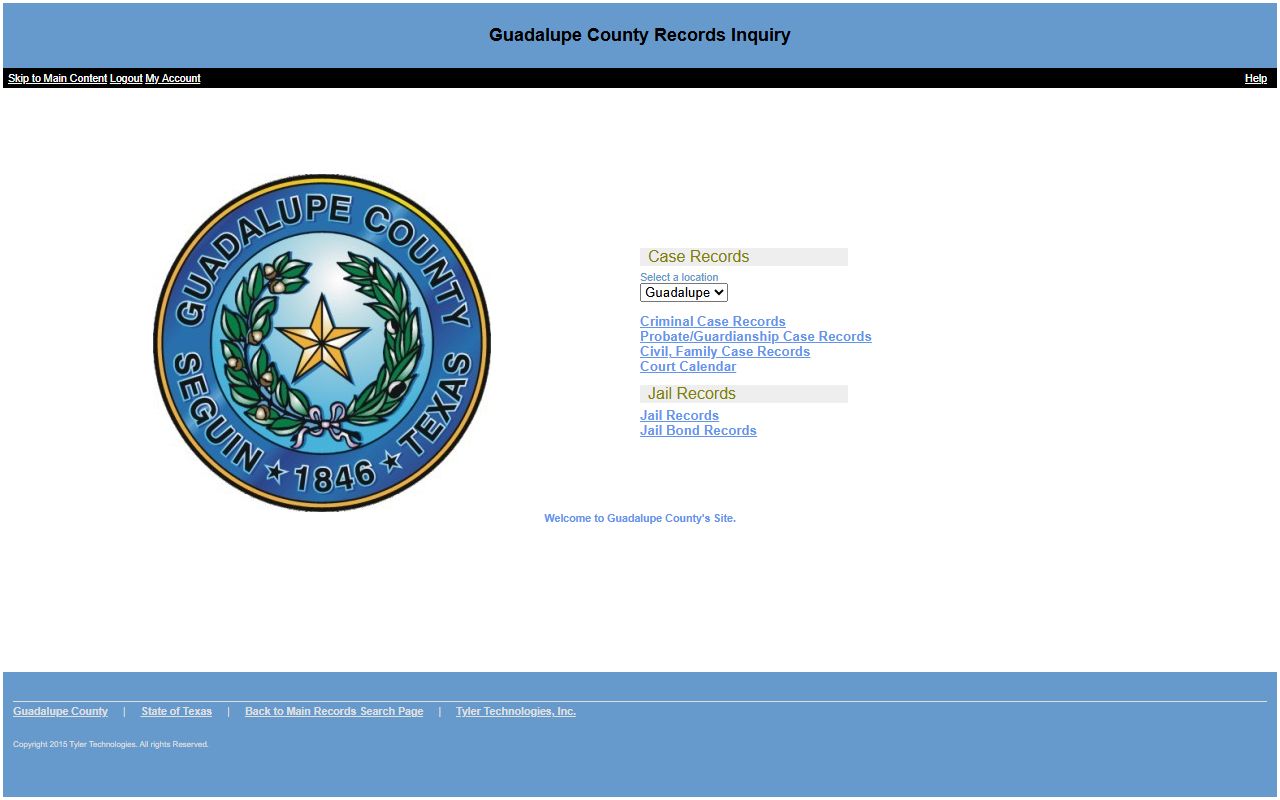
Because the portal was protected by human verification during research, court records after an arrest should be checked through a live browser and then confirmed with the proper clerk when copies or certified status are needed.
Guadalupe Court Portal Fields
Guadalupe County uses one Tyler Technologies PublicAccess portal for several record searches. The county A-Z labels are confirmed, but the exact fields within the portal were blocked by AWS WAF human verification. That matters because a name field, date field, case-number field, or hearing filter should not be treated as confirmed unless the portal is inspected by a human user.
| Confirmed Portal Label | Type | Field Status | Notes |
|---|---|---|---|
| Criminal Case Search | Portal link | Exact fields blocked | Official county A-Z route to Tyler PublicAccess. |
| Criminal Hearing Search | Portal link | Exact fields blocked | Used for hearing lookup when available after verification. |
| Judicial Records Search | Portal link | Exact fields blocked | General judicial-records route for the county portal. |
| JP Criminal Case Search | Portal link | Exact fields blocked | Justice of the Peace criminal case route. |
| Jail Records Search | Portal link | Exact fields blocked | Custody search route, not the same as filed court-charge status. |
Note: If a new case is not visible right after booking, the prosecutor may not have filed the final charge yet.
Charges Filed After Arrest
A jail arrest may begin with law-enforcement charge wording. The court record begins to take shape when the case is filed through the prosecution and clerk system. In Guadalupe County, misdemeanor and county-level routing should be checked through the County Attorney, County Clerk, and County Courts at Law. District felony court records should be routed through the District Clerk. The local jail's own numbers also show the bridge between custody and court: the Adult Detention Division reports thousands of inmate transfers to various courts each year.
| Document | Filed By | Common Use | What To Check |
|---|---|---|---|
| Complaint | Officer or prosecutor | Sworn allegation supporting prosecution or a warrant | Name, alleged offense, date, and probable-cause basis. |
| Information | Prosecutor | Prosecutor-filed charging instrument, often used in misdemeanor practice and some felony contexts | Filed charge, count, degree, and amendments. |
| Indictment | Grand jury | Grand-jury charging instrument, generally tied to felony prosecution | Returned counts, offense level, and district court case number. |
Booking charges and filed charges can differ. A person may be booked on one allegation, then charged with a revised offense after prosecutor review. Charges also may be added, reduced, amended, dismissed, or moved into a different case number. Court records after a jail arrest should therefore be compared by name, arrest date, case number, and charge wording instead of relying on one label from the jail intake stage.
Guadalupe Charge Status Terms
Charge status is the key distinction between an allegation and a result. A court record can show that a charge is pending even while the jail roster still reflects the first booking charge. It also can show that a charge was dismissed, reduced, deferred, resolved by plea, or tied to a warrant after missed court. Each count should be read separately because one case can contain several charges with different outcomes.
| Status | What It Means |
|---|---|
| Pending or active | The case or charge remains open and has not reached final disposition. |
| Amended or reduced | The prosecutor or court changed the charge wording, degree, or count from an earlier version. |
| Dismissed | The charge ended without a conviction on that count, though other counts may remain. |
| Disposed | The court entered an outcome, such as conviction, deferred disposition, dismissal, or other final action. |
| Warrant or FTA | A warrant, capias, or failure-to-appear issue may be tied to the case and can lead to arrest. |
Bond After Guadalupe Arrest
Bond is set after magistration, not by the online search page. The Guadalupe County jail page defines bail as security given by the accused to appear before the proper court. It says bail is not punishment and lists factors a magistrate may consider, including residence, employment, marital status, dependents, prior failures to appear, seriousness of the offense, and other risk factors. Texas Code of Criminal Procedure Article 15.17 governs the magistrate warning after arrest, and Chapter 17 governs bail.
| Bond Type | How It Works Locally |
|---|---|
| Cash bond | The defendant posts the bond amount with the court. The jail advises verifying procedure with the District Clerk for district cases or County Clerk for county matters. |
| Surety bond | A licensed bail bondsman posts the bond after the defendant or family makes private arrangements. |
| Personal bond | The person is released on recognizance without posting the full amount, but remains bound to appear in court. |
| No-bond or hold | A detainer, warrant from another agency, parole hold, TDCJ status, federal hold, or ICE detainer can prevent release even when local bond information exists. |
For current bond information, the local jail/bond line is (830) 303-6342. Guadalupe County is a Bail Bond Board county, and sheriff employees may not recommend a bondsman. The approved bonding-company list is available through the Sheriff's Office.
Warrants Before Court Records
Official Guadalupe County pages reviewed did not provide a separate active-warrant database with confirmed searchable fields. A warrant may still appear through related criminal, JP criminal, or hearing records in Tyler PublicAccess after human verification. For official routing, call the Guadalupe County Sheriff's Office 24-hour number at (830) 379-1224 or Metro at (830) 303-5241. Jail records and background-check routing uses (830) 303-6342 ext. 2239.
An arrest warrant authorizes arrest based on probable cause. A bench warrant or capias is court issued, often after a failure to appear or a court-order violation. A search warrant is different because it authorizes a search, not a custody lookup. A fugitive or hold warrant from another jurisdiction can keep a person in custody after a Guadalupe County arrest. The safest route is to contact the issuing court or counsel before appearing in person because resolving a warrant may lead to booking, bond, or a required court appearance.
Charges vs Convictions
An arrest and filed charge are not a conviction. Court records after a jail arrest may be public, but they often show an accusation at an early stage. A conviction requires a plea, verdict, or other court result. Charge status should be read with the disposition field and the final order, not just the initial booking label.
| Charge | Conviction | |
|---|---|---|
| Stage | Allegation filed or pending in court | Final result from a plea, verdict, or qualifying court action |
| Proof level | Based on probable cause and charging decisions | Requires proof beyond a reasonable doubt or a valid plea |
| Record meaning | Shows what was accused or filed | Shows that guilt or legal responsibility was established |
| Search caution | Can change, be reduced, or be dismissed | Still must be checked for appeals, deferred terms, or later relief |
Sealed vs Expunged Records
Texas record-clearing terms should not be used loosely. Texas Code of Criminal Procedure Chapter 55 governs expunction of eligible arrest records. Nondisclosure or sealing is a different form of relief that can limit public access without erasing every governmental record. Eligibility depends on the disposition, waiting periods, case type, prior history, and the court order actually signed.
| Sealed or Nondisclosed | Expunged | |
|---|---|---|
| Public visibility | Hidden from many public searches after an order, with exceptions. | Removed or treated as if the arrest did not occur for most purposes. |
| Government access | Some agencies may retain limited access as allowed by law. | Access is much more restricted after the expunction order is processed. |
| Typical basis | Eligible nondisclosure or sealing relief after qualifying outcomes. | Eligible dismissal, acquittal, no-charge, pardon, or other Chapter 55 grounds. |
| Practical step | Get the signed order and follow up with affected record holders. | Serve the signed expunction order on agencies and record publishers when required. |
Background Check Limits
Casual court lookup is not the same as a regulated background check. A Guadalupe County portal result may help identify a case, but employers, landlords, insurers, credit providers, and tenant-screening companies must follow the Fair Credit Reporting Act and other applicable laws when using criminal-history information for covered decisions. Local court records also may be incomplete if a case was sealed, expunged, transferred, recently filed, or not yet indexed.
Important: Informal court and jail lookups are not consumer reports and cannot be used for FCRA-covered screening decisions.
Restricted Guadalupe Court Records After Arrest
Texas Public Information Act access starts with existing records, but it does not require an office to create a new record, answer legal questions, or release confidential material. Guadalupe County's PIA page explains written requests and department routing. Law-enforcement material may be reviewed under Texas Government Code Chapter 552, including Section 552.108(c), which preserves access to basic information about an arrested person, arrest, or crime while still allowing confidential details to be withheld or redacted.
Juvenile records, victim information, medical information, active-investigation material, sealed cases, expunged arrests, and confidential court filings may not be publicly available. For sheriff or jail records not online, the GCSO open-records route accepts written requests in the sheriff lobby, by mail, or by email at so.openrecords@guadalupetx.gov. For court records after a jail arrest, use the clerk that holds the case file rather than sending every request to the jail.
Public Record Search
Sponsored Results